Showing posts with label Aldgate. Show all posts

Thursday, 8 December 2011

Tales from the Parish Clerks’ Memoranda No.13: The Final Tale


For this the thirteenth and final Tale from the Parish Clerks’ Memoranda for the ReScript blog, I wanted to take a moment to reflect on the processes of record-keeping, stretching from the painstakingly hand-written Memorandum Book entries of the 16th century, to the painstakingly key-tagged digital renditions of the same for the very modern ReScript editing interface, that have combined to help bring the parishioners of St Botolphs without Aldgate vividly to life for 21st century historians.

Because the memorandum books were written freehand, with no standardised spelling, and without a terribly strict format, the amount of automated key-tagging that we were able to do was very limited. This meant that I had to check every single entry to try to ensure that everything a historian might feasibly want to search for using ReScript could be easily found. I confess that sometimes, especially in the early stages of the work, this could feel quite tedious.

But an interesting thing happened as the work progressed: as I ploughed through innumerable notices of births, engagements, weddings, and funerals, I started to get a sense of the rhythm of life in the parish. I found myself picturing dancing and celebration at the weddings, and feeling fearful for the fate of infants who were in such poor health that they had to be baptised at home instead of at the church. I grew to recognise some of the parishioners and church officials who appeared in the records again and again, like the wonderfully named Balthazar Piggin. And I felt a sense of dread as the first mentions of plague began to appear in the records.

I also began to feel a strange synchronicity with the parish clerks. They and I both tended to stumble and make errors when we had to undertake particularly long and repetitive entries of events (their errors remain visible for all time while mine, mercifully, could be corrected out of existence). And I could practically hear their heavy sighs of resignation when yet another funeral service had to be marked “unpaid”. The role of the church in marking every milestone of the lives of the parishioners – and of many non-parishioners – of their little area of London meant that the ministers and parish clerks probably knew more about the goings-on of the neighbourhood than anyone else.

Having key-tagged countless instances of Mr Hayes the minister flawlessly fulfilling his duties, I found that the following entry rendered him endearingly more human:
14 Iune Ano 1589
Judith Hall the dawghter of Edmund Hall a Surngionn Dwellinge in mother Figgis Alye beinge in the High Streete was cristned the xiiijth Day of June anno 1589 By the minester of Creechurche mr Cowse For that mr Hayse was not well or a Slepe
P69/BOT2/A/019/MS09234/001 fol. 68r
It was the “…or asleep” that tickled me. To conclude this series, I leave you with Mr Hayse’s heroic attempt five years earlier at forcibly establishing brotherly love amongst the parishioners:
24 Maye 1584
Coone clarke was put by the communion
Memerandumm that mr Hayze wt the consent of Bothe the church wardens ded putt Coone clarke and his Wyfe From Receyvinge the comunion the xxiiijth Daye of maye in ano 1584 For that theye Weare not in love and charetie with their neyghbores Hentell Suche tyme as theie Do reconsyle them selves
P69/BOT2/A/019/MS09234/001 fol. 55r
Thank you to everyone who has been following Tales from the Parish Clerks’ Memoranda. I have thoroughly enjoyed writing it, and hope that you will keep checking in to the blog to chart the progress of ReScript as Bruce Tate and the team continue their excellent and innovative work. And be sure to stay in love and charity with your neighbours. It’s what Mr Hayes would have wanted.

Many thanks to St Botolph without Aldgate and London Metropolitan Archives for permission to reprint extracts from the Parish Clerks' Memoranda.

The Parish Clerks' Memoranda transcripts were prepared by the Centre for Metropolitan History team as part of their Economic and Social Research Council-funded Life in the Suburbs project (Grant Reference: RES-062-23-1260; http://www.history.ac.uk/projects/life-in-the-suburbs).

Friday, 11 November 2011

Tales from the Parish Clerks’ Memoranda No.11: Beating the Bounds


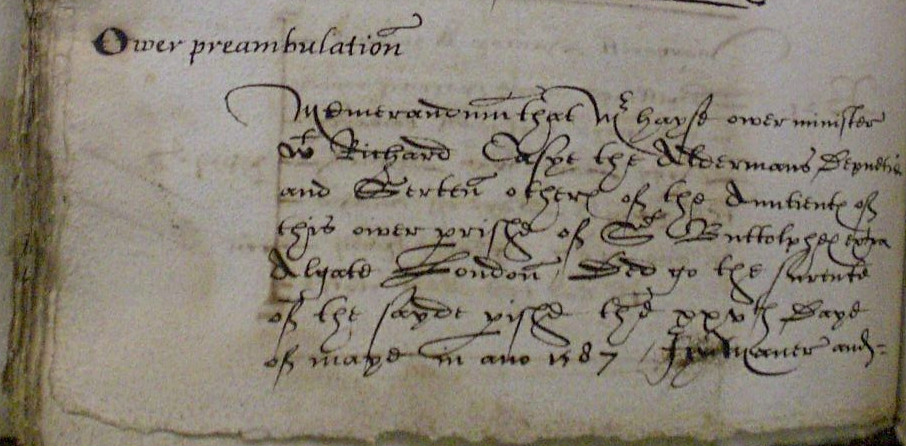
The year 1587 was an interesting time for the rowdy ritual perambulation known as “beating the bounds”, in which parishioners set out en masse with large wooden sticks to confirm the boundaries of their parish. Originating as a pre-Christian practice, beating the bounds served the very practical purpose of ensuring that each successive generation of a largely illiterate community knew the boundaries of their own area, in order to make sure that no over-zealous adjacent land-owner encroached on their territory. But it also provided an excuse for a raucous day out, in which the locals, traditionally partaking of ale and bread (one suspects more of the former than the latter), would set out to impress upon the young lads of the community the extent of the region to which they owed allegiance. And when I say “impress upon”, I unfortunately mean this literally. In medieval times, the young boys were likely to be beaten with sticks, thrown over walls, or turned upside down to have their heads knocked against the actual boundary stones to make sure that they remembered where these were. Clearly, the links between trauma-induced brain damage and loss of memory had not yet been established. In Elizabeth I’s reign, the mob-like quality of these outings was toned down considerably, but there were still hazards to making the parish perambulation...
25 Maye Ano 1587

Ower preambulationn
Memerandumm that Mr Hayse ower minister wt Richard Casye the aldermans Depuetie and Sertenn otheres of the Auntientes of this ower parishe of St Buttolphes extra Algate Londonn Ded go the Surcute of the Sayde parishe the xxvth Daye of maye in ano 1587 In Maner and Forme Followinge at the Whiche tyme theie ded Beginn there Surcute Fromm the churche & So thorowe the churche yearde and thorowe Mris Shingwelles howse Beinge Builte of part of the churcheyeard And fromm thence theye Went to Whightchappell Barres retorninge from thence to Sparrowes corner and So went downe Hogg Lane and So went thorowe the Well close and from thence theye went or ded go Downe Nyghtingeale Lane and to to the midle of the mill theare where the 100 psalme was Songe and mr Hayes Havinge Read ann Epistell wt a gospell and havinge also prayed for the Longe preservationn of the Queenes Moste exilent Matie we ded go from thence thorowe St Katherynes and So a longe By the Iorene gate of the tower up towardes the pownde and there kepinge the Queenes Maties Highe waye towardes the postarne we weare there mett By onne Jhon Phillips the under porter of the tower beinge Accommpaned Withe three warderes of the tower the wch three Warderes had there halbardes and there neckes and the Sayde Jhon phillips Demanded of the minester wt the rest whether theye Weare goinge that waye the wch minester wt the rest Aunswered that accordinge to the Queenes Maties Lawse and Awnsient costom they Weare goinge towardes the posterne where theye Ded meane to Reade a gospell accordinge as they Weare Wonte to do unto whom the Sayd Jhon Phillips And the rest with him Sayde that the liefe tenaunnt had commanded the contrarye Wherefore he chardged the Whole companye in the Queenes Maties name not to comm any nearer that waye for if that theye Ded comme anye Nearer that it Showld be upon there owne parcell, But willed them to go up towardes the crosse Whiche thinge the minester withe the rest accompaninge hem Ded Did, and at the Sayde crosse the 117 psalme beinge Sonnge and a gospell red the Minister wt the rest of the parishioneres Ded go a longe towardes algate and So from thence theye Ded go to the mother Jacksons howse in Hownsdiche and a part of the 103 psalme beinge Songe and A gospell Read the Sayde minester ded go From thence into the churche wheare the Lettanye wt the Soffrages beinge Redd the minester and the parsihioneres Ded depart in peace et ces

P69/BOT2/A/019/MS09234/001 fol 78v

I can’t help feeling sorry for poor Mrs Shingwelle who had to put up with all and sundry tramping through her house! But why did the parishioners have such a difficult time when they reached the postern gate of the Tower of London? The ever-obliging Mark Merry explains: “The reason the parishioners/parish officers were turned away from the Tower – somewhat ostentatiously on occasion! – was that the Tower was a (Peculiar) Liberty free from the jurisdiction of both the City corporation and the normal parish/Church administrative system. As with all the Liberties they were constantly being pressed into defending their privileges and freedoms in the face of encroachment from the City/ parishes, and so met the perambulators of Aldgate on their annual stroll to make the point ceremoniously and symbolically that they had no claim on the Tower.”

Well, thank goodness we no longer have disputes between the Corporation, the Church, and the good people of London about the proper use of public space in the City…

Today, the bounds of Portsoken Ward, in which St Botolphs without Aldgate is located, are still ceremoniously marked every year – as are those of the Tower of London – although I am happy to report that instead of beating the children with sticks, the children instead now use the sticks to beat the boundary markers. This is a very colourful ceremony as can be seen in these excellent photos from the 2010 beating of the bounds of Portsoken Ward.

Many thanks to St Botolph without Aldgate and London Metropolitan Archives for permission to reprint extracts from the Parish Clerks' Memoranda.

The Parish Clerks' Memoranda transcripts were prepared by the Centre for Metropolitan History team as part of their Economic and Social Research Council-funded Life in the Suburbs project (Grant Reference: RES-062-23-1260; http://www.history.ac.uk/projects/life-in-the-suburbs).