Showing posts with label Elizabeth I. Show all posts

Friday, 25 November 2011

Tales from the Parish Clerks’ Memoranda No.12: A Tale of Two Pirates


When is a pirate not a pirate? In 16th century London the distinction could mean the difference between being hailed as a hero, or swinging from the gallows at Wapping. In August 1587, Thomas Conodale found himself on the wrong end of this distinction:
30 Awgust Ano 1587: burial

Thomas Conodale beinge A Batchelor He was Borne in Glossester beinge A Sea Faringe man and executed at wappinge For pyracye the xxxth daye of Awgust in ano 1587 betwixt the ower of too and three of the clocke was Buried the Sayde xxxth Daye of awgust in ano 1587
beinge xxviij yeares owlde no parishioner For the minester ijs For the grownd in the common churche yeard xijd For the Second clothe xd For the pitt & knell ijs viijd For the clarkes atendance viijd For the Sextenes attendance iiijd he was exicuted at Waping
P69/BOT2/A/019/MS09234/001 fol 128r

How I wish the High Court of Admiralty records were digitised and available online! These contain all records of prosecutions for piracy and would be very helpful for learning more about Conodale’s circumstances. That his body was buried rather than being publicly displayed on Execution Dock indicates that he was considered a small fish. Notorious pirates were left on the gibbet until three tides had washed over them, and then their remains were often covered in tar (to slow the process of decay) and displayed hanging in chains as a warning to other seafaring men.

If you had a talent for ocean-based looting and violence but did not much fancy being hanged as a criminal, you could always join up with a captain who had been granted a Letter of Marque from the monarch. This document essentially provided a license for “privateering”, or legal piracy, and was in use in England from the 16th to the 19th centuries. As ever, when goods are being appropriated, the distinction between whether it is considered a criminal or legitimate act depends on who is doing the pilfering – and who gets the spoils. In 1587, Sir Francis Drake was England’s most successful privateer, seizing Spanish ships and goods from as far afield as the Caribbean and presenting the booty to Elizabeth I. The following excerpt from the Calendar of State Papers Relating to English Affairs in the Archives of Venice, Volume 8: 1581-1591 accessed from British History Online demonstrates just how lucrative such activities could be:
July 17. Original Despatch, Venetian Archives.
Letters from England, dated the 9th inst., announce the arrival of Drake at Plymouth. After having worked great havoc on the coast of Spain he had seized one large galleon, called the S. Lorenzo, on its way from Calicut with a cargo of spices to the value of a million of gold, and ten other ships with sugar, cotton, and various merchandise on their way from Brazil. In London there were great signs of rejoicing, and the Queen sent two gentlemen to meet Drake and to do him honour. Sugar is so cheap there that what costs five reals here is sold for half a real the pound there.

This is only one example of the riches Drake brought to Elizabeth: amazingly, he eventually seized enough goods to pay off the national debt in its entirety, for which service he was duly knighted and paid handsomely enough to be able to buy Buckland Abbey in Devon. The circumstances of his crew members were considerably less exalted, and the Parish Clerks’ Memoranda books contain many references to sailors returning from Drake’s expeditions in ill health and with little money, ending their lives in lodgings:
5 Iulye Ano 1587

Roger Gillisonn beinge a Sayler & a Stranger whose Dwellinge was in westcaple in Sealand he was Browght from Spayne in Sr Frauncis Dracke his Ships and Beinge Sicke was Lodged at the Howse of EdwardWynard a victulor Dwellinge at the Signe of the Flower de luce beinge in the libertie of east Smithfield wheare he endid his Lyfe and was Buried the vth Daye of Julye in ano 1587
P69/BOT2/A/019/MS09234/001 fol100r

Thomas Conodale and Roger Gillisonn: both minor players in the colourful 16th century saga of piracy. One ended his life “dancing the hempen jig”, the other dying among strangers far from home. Whether deemed criminal or legitimate, a pirate's life was a far cry from our romanticised notions. This would never happen to Johnny Depp…

Many thanks to St Botolph without Aldgate and London Metropolitan Archives for permission to reprint extracts from the Parish Clerks' Memoranda.

The Parish Clerks' Memoranda transcripts were prepared by the Centre for Metropolitan History team as part of their Economic and Social Research Council-funded Life in the Suburbs project (Grant Reference: RES-062-23-1260).

Friday, 30 September 2011

Tales from the Parish Clerks’ Memoranda No.8: The overworked student and his surprising connections


Today we have both a cautionary tale on the dangers of “Imoderate studye” for all new and returning University students, and a very exciting bit of celebrity spotting 16th century style.
20 Awgust Ano 1587
A colexionn for one Frauncis [W]orlocke a batchelor of arte in oxford who Was becomme blynde and Lame wth Imoderate studye
Memerandum that a colexionn was gathered in ower parishe Churche the xxth Daye of awgust in ano 1587 By vertue of the Queenes Maties letteres pattens and was for one Frauncis Worlocke beinge a Batchelor of arte in Oxford and sonne to the lorde of Hunsdon Lorde Chamberlin his owld Servant Who by Imoderate Studye & other misfortunes Is become blynde ["blynde" inserted with a caret] lame & Impotent & that for want of Habillytye & mayntenance is forced to Seeke the Benevolence of Well disposed people in Consideration Whereof the Sayde frauncis Worlocke Was lysenced by Hemselfe or by his Deputie to aske gather receyve or take thalmes charretye or Devotion ower Lovinge Subiectes Inhabetinge & Dwellinge wthin the Countie of Midlesex and essex withe ower townes of Cowlchester and Mawldon and not els wheare towardes his Sayde reliefe the wch Sayde Letteres pattens weare to [erasure: probably another version of continue] Continewe for the Space of one Whole yeare beinge dated the xiiijth Daye of december in the xxixth yeare of her Maties Raigne & there was gathered for him the 20th daye of awgust aforesayde By Richard bigges beinge Constable the Some of ijs jd ob q
P69/BOT2/A/019/MS09234/001 fol. 121r

Poor Francis – that was very bad luck indeed. And there is no record of him in the Alumni Oxonienses for this period, so it would appear that in spite of the contributions of the good parishioners he was unable to complete his degree. A very sad Tale.

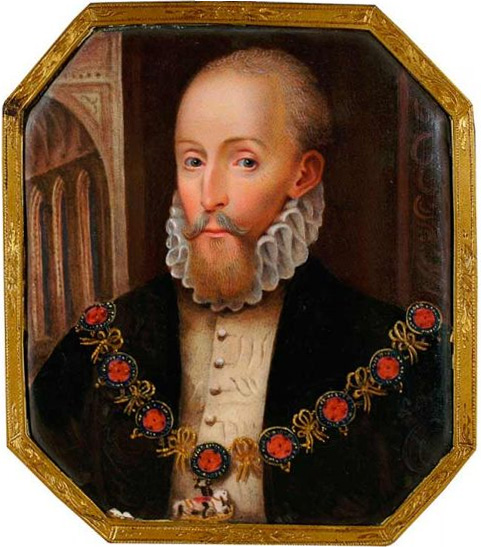
But why, instead of giving details of Francis’ father in this entry, did the Parish Clerk instead focus on the father’s employer, the Lord of Hunsdon? I suspect, readers, that our Parish Clerk was happy to have an excuse to list such a celebrated person in his Memorandum Book. For the Lord of Hunsdon was none other than Henry Carey: cousin to Elizabeth I, son of Mary Boleyn, nephew of Anne Boleyn, and although publicly acknowledged as the son of the courtier William Carey, widely rumoured to be the biological son of Henry VIII. As if these exciting and rather titillating associations were not interesting enough, Henry Carey also had one more notable connection. Following a distinguished military career, he was appointed Lord Chamberlain in 1585 and was responsible for organising all court functions for his royal cousin. As part of his duties, he became the first patron of The Lord Chamberlain’s Men, a troupe of professional actors including (drum roll, please) William Shakespeare. Henry Carey was most definitely a notable celebrity.

So who was Francis’ father, described only as the “owld Servant” of Lord Hunsdon? A bit of digging on British History Online revealed that Francis Worlocke’s father was Captain Edward Worlock (spellings were far from consistent in the 16th century), who served as “muster master” for Lord Hunsdon. This wonderfully-named occupation was a fairly senior military post which entailed responsibility for organising the bands of soldiers that had to be supplied by English lords to fight the Crown’s wars. So Captain Worlock was a man of no small importance himself.

At this point I got a bit carried away and spent the princely sum of £3.50 to access the last will and testament of Henry Carey from the National Archives. Carey died in July 1596: would he have left anything for the struggling son of his “owld Servant”? I drew on my ever-helpful colleague Mark Merry’s skills to decipher the will:

What is interesting is that that the Queen promises to look after his old servants. Given this is after the St Botolph collection for Worlocke, this might not have been much help to the blind student, but it does suggest that Carey had a strong concern for his servants (and a close association with Elizabeth)... What an excellent example of some humble little local event feeding into a much bigger picture – and poor old Francis only got a couple of shillings out of the whole thing!


This is one of the particularly exciting aspects of working with the Parish Clerks’ Memoranda. You never know where an apparently “small” story will lead. It just takes a bit of digging.


Many thanks to St Botolph without Aldgate and London Metropolitan Archives for permission to reprint extracts from the Parish Clerks' Memoranda.

The Parish Clerks' Memoranda transcripts were prepared by the Centre for Metropolitan History team as part of their Economic and Social Research Council-funded Life in the Suburbs project (Grant Reference: RES-062-23-1260;
http://www.history.ac.uk/projects/life-in-the-suburbs).