Showing posts with label London. Show all posts

Thursday, 8 December 2011

Tales from the Parish Clerks’ Memoranda No.13: The Final Tale


For this the thirteenth and final Tale from the Parish Clerks’ Memoranda for the ReScript blog, I wanted to take a moment to reflect on the processes of record-keeping, stretching from the painstakingly hand-written Memorandum Book entries of the 16th century, to the painstakingly key-tagged digital renditions of the same for the very modern ReScript editing interface, that have combined to help bring the parishioners of St Botolphs without Aldgate vividly to life for 21st century historians.

Because the memorandum books were written freehand, with no standardised spelling, and without a terribly strict format, the amount of automated key-tagging that we were able to do was very limited. This meant that I had to check every single entry to try to ensure that everything a historian might feasibly want to search for using ReScript could be easily found. I confess that sometimes, especially in the early stages of the work, this could feel quite tedious.

But an interesting thing happened as the work progressed: as I ploughed through innumerable notices of births, engagements, weddings, and funerals, I started to get a sense of the rhythm of life in the parish. I found myself picturing dancing and celebration at the weddings, and feeling fearful for the fate of infants who were in such poor health that they had to be baptised at home instead of at the church. I grew to recognise some of the parishioners and church officials who appeared in the records again and again, like the wonderfully named Balthazar Piggin. And I felt a sense of dread as the first mentions of plague began to appear in the records.

I also began to feel a strange synchronicity with the parish clerks. They and I both tended to stumble and make errors when we had to undertake particularly long and repetitive entries of events (their errors remain visible for all time while mine, mercifully, could be corrected out of existence). And I could practically hear their heavy sighs of resignation when yet another funeral service had to be marked “unpaid”. The role of the church in marking every milestone of the lives of the parishioners – and of many non-parishioners – of their little area of London meant that the ministers and parish clerks probably knew more about the goings-on of the neighbourhood than anyone else.

Having key-tagged countless instances of Mr Hayes the minister flawlessly fulfilling his duties, I found that the following entry rendered him endearingly more human:
14 Iune Ano 1589
Judith Hall the dawghter of Edmund Hall a Surngionn Dwellinge in mother Figgis Alye beinge in the High Streete was cristned the xiiijth Day of June anno 1589 By the minester of Creechurche mr Cowse For that mr Hayse was not well or a Slepe
P69/BOT2/A/019/MS09234/001 fol. 68r
It was the “…or asleep” that tickled me. To conclude this series, I leave you with Mr Hayse’s heroic attempt five years earlier at forcibly establishing brotherly love amongst the parishioners:
24 Maye 1584
Coone clarke was put by the communion
Memerandumm that mr Hayze wt the consent of Bothe the church wardens ded putt Coone clarke and his Wyfe From Receyvinge the comunion the xxiiijth Daye of maye in ano 1584 For that theye Weare not in love and charetie with their neyghbores Hentell Suche tyme as theie Do reconsyle them selves
P69/BOT2/A/019/MS09234/001 fol. 55r
Thank you to everyone who has been following Tales from the Parish Clerks’ Memoranda. I have thoroughly enjoyed writing it, and hope that you will keep checking in to the blog to chart the progress of ReScript as Bruce Tate and the team continue their excellent and innovative work. And be sure to stay in love and charity with your neighbours. It’s what Mr Hayes would have wanted.

Many thanks to St Botolph without Aldgate and London Metropolitan Archives for permission to reprint extracts from the Parish Clerks' Memoranda.

The Parish Clerks' Memoranda transcripts were prepared by the Centre for Metropolitan History team as part of their Economic and Social Research Council-funded Life in the Suburbs project (Grant Reference: RES-062-23-1260; http://www.history.ac.uk/projects/life-in-the-suburbs).

Friday, 11 November 2011

Tales from the Parish Clerks’ Memoranda No.11: Beating the Bounds


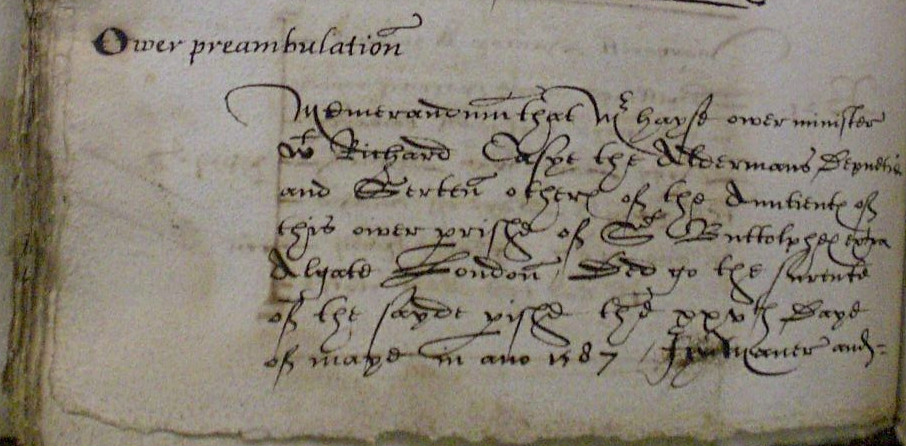
The year 1587 was an interesting time for the rowdy ritual perambulation known as “beating the bounds”, in which parishioners set out en masse with large wooden sticks to confirm the boundaries of their parish. Originating as a pre-Christian practice, beating the bounds served the very practical purpose of ensuring that each successive generation of a largely illiterate community knew the boundaries of their own area, in order to make sure that no over-zealous adjacent land-owner encroached on their territory. But it also provided an excuse for a raucous day out, in which the locals, traditionally partaking of ale and bread (one suspects more of the former than the latter), would set out to impress upon the young lads of the community the extent of the region to which they owed allegiance. And when I say “impress upon”, I unfortunately mean this literally. In medieval times, the young boys were likely to be beaten with sticks, thrown over walls, or turned upside down to have their heads knocked against the actual boundary stones to make sure that they remembered where these were. Clearly, the links between trauma-induced brain damage and loss of memory had not yet been established. In Elizabeth I’s reign, the mob-like quality of these outings was toned down considerably, but there were still hazards to making the parish perambulation...
25 Maye Ano 1587

Ower preambulationn
Memerandumm that Mr Hayse ower minister wt Richard Casye the aldermans Depuetie and Sertenn otheres of the Auntientes of this ower parishe of St Buttolphes extra Algate Londonn Ded go the Surcute of the Sayde parishe the xxvth Daye of maye in ano 1587 In Maner and Forme Followinge at the Whiche tyme theie ded Beginn there Surcute Fromm the churche & So thorowe the churche yearde and thorowe Mris Shingwelles howse Beinge Builte of part of the churcheyeard And fromm thence theye Went to Whightchappell Barres retorninge from thence to Sparrowes corner and So went downe Hogg Lane and So went thorowe the Well close and from thence theye went or ded go Downe Nyghtingeale Lane and to to the midle of the mill theare where the 100 psalme was Songe and mr Hayes Havinge Read ann Epistell wt a gospell and havinge also prayed for the Longe preservationn of the Queenes Moste exilent Matie we ded go from thence thorowe St Katherynes and So a longe By the Iorene gate of the tower up towardes the pownde and there kepinge the Queenes Maties Highe waye towardes the postarne we weare there mett By onne Jhon Phillips the under porter of the tower beinge Accommpaned Withe three warderes of the tower the wch three Warderes had there halbardes and there neckes and the Sayde Jhon phillips Demanded of the minester wt the rest whether theye Weare goinge that waye the wch minester wt the rest Aunswered that accordinge to the Queenes Maties Lawse and Awnsient costom they Weare goinge towardes the posterne where theye Ded meane to Reade a gospell accordinge as they Weare Wonte to do unto whom the Sayd Jhon Phillips And the rest with him Sayde that the liefe tenaunnt had commanded the contrarye Wherefore he chardged the Whole companye in the Queenes Maties name not to comm any nearer that waye for if that theye Ded comme anye Nearer that it Showld be upon there owne parcell, But willed them to go up towardes the crosse Whiche thinge the minester withe the rest accompaninge hem Ded Did, and at the Sayde crosse the 117 psalme beinge Sonnge and a gospell red the Minister wt the rest of the parishioneres Ded go a longe towardes algate and So from thence theye Ded go to the mother Jacksons howse in Hownsdiche and a part of the 103 psalme beinge Songe and A gospell Read the Sayde minester ded go From thence into the churche wheare the Lettanye wt the Soffrages beinge Redd the minester and the parsihioneres Ded depart in peace et ces

P69/BOT2/A/019/MS09234/001 fol 78v

I can’t help feeling sorry for poor Mrs Shingwelle who had to put up with all and sundry tramping through her house! But why did the parishioners have such a difficult time when they reached the postern gate of the Tower of London? The ever-obliging Mark Merry explains: “The reason the parishioners/parish officers were turned away from the Tower – somewhat ostentatiously on occasion! – was that the Tower was a (Peculiar) Liberty free from the jurisdiction of both the City corporation and the normal parish/Church administrative system. As with all the Liberties they were constantly being pressed into defending their privileges and freedoms in the face of encroachment from the City/ parishes, and so met the perambulators of Aldgate on their annual stroll to make the point ceremoniously and symbolically that they had no claim on the Tower.”

Well, thank goodness we no longer have disputes between the Corporation, the Church, and the good people of London about the proper use of public space in the City…

Today, the bounds of Portsoken Ward, in which St Botolphs without Aldgate is located, are still ceremoniously marked every year – as are those of the Tower of London – although I am happy to report that instead of beating the children with sticks, the children instead now use the sticks to beat the boundary markers. This is a very colourful ceremony as can be seen in these excellent photos from the 2010 beating of the bounds of Portsoken Ward.

Many thanks to St Botolph without Aldgate and London Metropolitan Archives for permission to reprint extracts from the Parish Clerks' Memoranda.

The Parish Clerks' Memoranda transcripts were prepared by the Centre for Metropolitan History team as part of their Economic and Social Research Council-funded Life in the Suburbs project (Grant Reference: RES-062-23-1260; http://www.history.ac.uk/projects/life-in-the-suburbs).

Friday, 2 September 2011

Tales from the Parish Clerks’ Memoranda No.6: The devil as a roaring lion walketh about seeking whom he may devour


This week we discover an instance of institutional kindness – unusual in the early 17th century – following the suicide of a maid of East Smithfield.


7 October 1616
Mary Play, a Maid of East smithfeild, who poysened hir selfe, in the house of hir Maister, Mr John Barbour, was (by a Licence from my Lord Bishoppe of London) buried in our new Church-yard, without any buriall Service, shee was coffind, and had our Black Cloth, Be Sober and watch, for your aduersary the Divel, as a roaring lion walketh abour, Seeking whom he may devour. 1 Peter. 5 Chap. 8 verse
P69/BOT2/A/003/MS09223 f262v


The first thing that struck me about this entry was the choice of scripture, which seemed to express a great sympathy for the unfortunate Mary Play. This made me wonder if John Clerke (the aptly-named Parish Clerk) and church leaders had information about the circumstances of Mary’s suicide that left them feeling sympathetic rather than merely condemnatory towards her actions as was more usual at this time. We will, of course, never know, but the choice of Bible verse sounded so heartfelt that it I couldn’t help but wonder.


The second particularly interesting thing about this was the fact that Mary was buried in hallowed ground – without a Christian burial service, but in hallowed ground nonetheless – the church having sought permission from the Lord Bishop of London. It was more usual at this time for suicides not only to be denied burial in hallowed ground, but often to suffer descecration of their corpses, and punishment of their families.1


It wasn’t until later in the seventeenth and eighteenth centuries that suicide began to be viewed not as a sinful decision made voluntarily, but as the result of melancholy madness which was beyond the control of the unfortunate victim. Martin Luther went so far as to argue that suicides were driven to their deaths by the devil, and that they – and their families – therefore could not be held responsible for their actions.2 Our Parish Clerk seems to be of this view as well.


By the early 1700s, the laws disgracing suicides and punishing their families gradually disappeared, and a more humane approach was adopted across Europe.3 It would be interesting to find out how many licences allowing suicides to be buried in hallowed ground were granted by John King, the Lord Bishop of London from 1611 to 1621. I know that he was a well-known Calivinist and anti-Catholic preacher before being appointed Lord Bishop. Did this make him more willing to challenge the dogma of the day? It would certainly appear that at least in this instance he, and St Boltolph’s, were very much ahead of their time.

1 Gale Encyclopaedia of the Early Modern World. http://www.answers.com/topic/suicide accessed 16 August 2011
2 ibid.
3 Sleepless Souls: Suicide in Early Modern England (1990) Michael MacDonald, Terence R. Murphy. Oxford University Press


Many thanks to St Botolph without Aldgate and London Metropolitan Archives for permission to reprint extracts from the Parish Clerks' Memoranda.

The Parish Clerks' Memoranda transcripts were prepared by the Centre for Metropolitan History team as part of their Economic and Social Research Council-funded Life in the Suburbs project (Grant Reference: RES-062-23-1260; http://www.history.ac.uk/projects/life-in-the-suburbs).

Friday, 19 August 2011

Tales from the Parish Clerks’ Memoranda No.5: Naming and Shaming


Even though urbanisation had led to greater flux in the population of 16th century London, parish communities such as that of St Botolph’s without Aldgate remained tightly knit groups, where protecting one’s reputation and avoiding the opprobrium of one’s neighbours were powerful motivating forces. Nowhere is this more apparent than in the church’s stance on sexual misconduct, where the involvement of the wider congregation played a key role, as Edith Ellis found when she and her husband were accused of consorting with women of ill repute...
19 Ianewary 1583
Richard Ellis and his wife weare Adioyned To make Thier purgation of thier Suspected evell Lyfe
Memerandumm that Richard ellis and his wyfe beinge presented by the church warden and Swornemen to live verye Suspitiuslye and contrarye to Lawe, by the wch prsentment beinge Suspeckted, it apeared that it was for receyvinge of Lyght women and for Suspition of Bawdrye
The Sayde wyfe whose Christian name is Edithe apearinge and Juditiallye answeringe ther to hathe denyed herselfe to be giltye thereof and thereupon She is inioyned to make her canonycall purgation therof in dewe forme of Lawe in the consistorye place in powles churche London upon Wensdaye beinge the xxixth daye of Janewary 1583 Betwene Howeres of ix ands xj of the clocke before noone wt Six honest women her neygbores beinge parishoneres and Inhabitantes of the parishe of St bottolphes extra algate of good and honest name fame and credit. These wordes weare pronownsed in ower parishe churche this xixth daye of Janewa'y in ano 1583
P69/BOT2/A/019/MS09234/001 fol.13r
You may have noticed that although both Richard and Edith were accused, it would appear that only Edith had to answer to her peers to make her purgation. The Parish Clerk gave no explanation of this, other than stating that Edith had denied being guilty of the charges. I could find no further mention of Richard Ellis, for example as having been excommunicated, so his fate remains a mystery.

Barely a week had passed before another scandal came to the community’s attention: there was a love rat within their midst...
26 Ianewary 1583
Iost Williamson Alijs Soll his penance
Jost Williamson alijs Soll a dutchmann beinge a cutler and Dwellinge in whightchapell parishe Ded pennance in a whyghet sheete in ower parishe churche of St buttolphes wt owt allgate London the xxvjth daye of Janewarye in ano 1583 And was For contracktinge him selfe unto one womann, and marryenge wt an other contrarye to the Law cannonicall
P69/BOT2/A/019/MS09234/001 fol.16r
Now this is interesting as it is an example of a well-documented form of shaming punishment which appears to have originated in medieval times and continued through until the 18th century, known as “sheet penance”. Being paraded before one’s fellow parishioners in a white sheet brought the penitent’s private indiscretions into the full glare of the public view just as effectively as today’s tabloid press exposés of Jost’s modern equivalents. But in the closely-knit communities of the 16th century, the potential repercussions were potentially more damaging, as those who were named and shamed could find themselves expelled from the community as well as publicly humiliated. Shakespeare drew on this practice in Henry VIth part 2, when he portrayed Humphrey’s wife Eleanor being led through the streets wearing a white sheet and carrying a candle after being accused of dabbling in witchcraft in order to further her husband’s political career, before being promptly banished.

I have been unable to find any information about how these practices originated, and what exactly was represented by the white sheet and candles. If any historians can shed a bit of light on this, or if you have further interesting information on shaming punishments in medieval or Early Modern England, please do let us know!

To return our Tales from St Botolph’s, I can only imagine the heavy sigh with which Mr Hayes the minister prepared his homily for that week:
26 Ianewary 1583
A part of a homelye read
A part of a homelye conserninge the dewties of maried folkes was Red in ower churche by mr Hayes the xxvjth day of Janewarye in ano 1583
P69/BOT2/A/019/MS09234/001 fol.16r

Many thanks to St Botolph without Aldgate and London Metropolitan Archives for permission to reprint extracts from the Parish Clerks' Memoranda.

The Parish Clerks' Memoranda transcripts were prepared by the Centre for Metropolitan History team as part of their Economic and Social Research Council-funded Life in the Suburbs project (Grant Reference: RES-062-23-1260;
http://www.history.ac.uk/projects/life-in-the-suburbs).